What happens during a consultation?
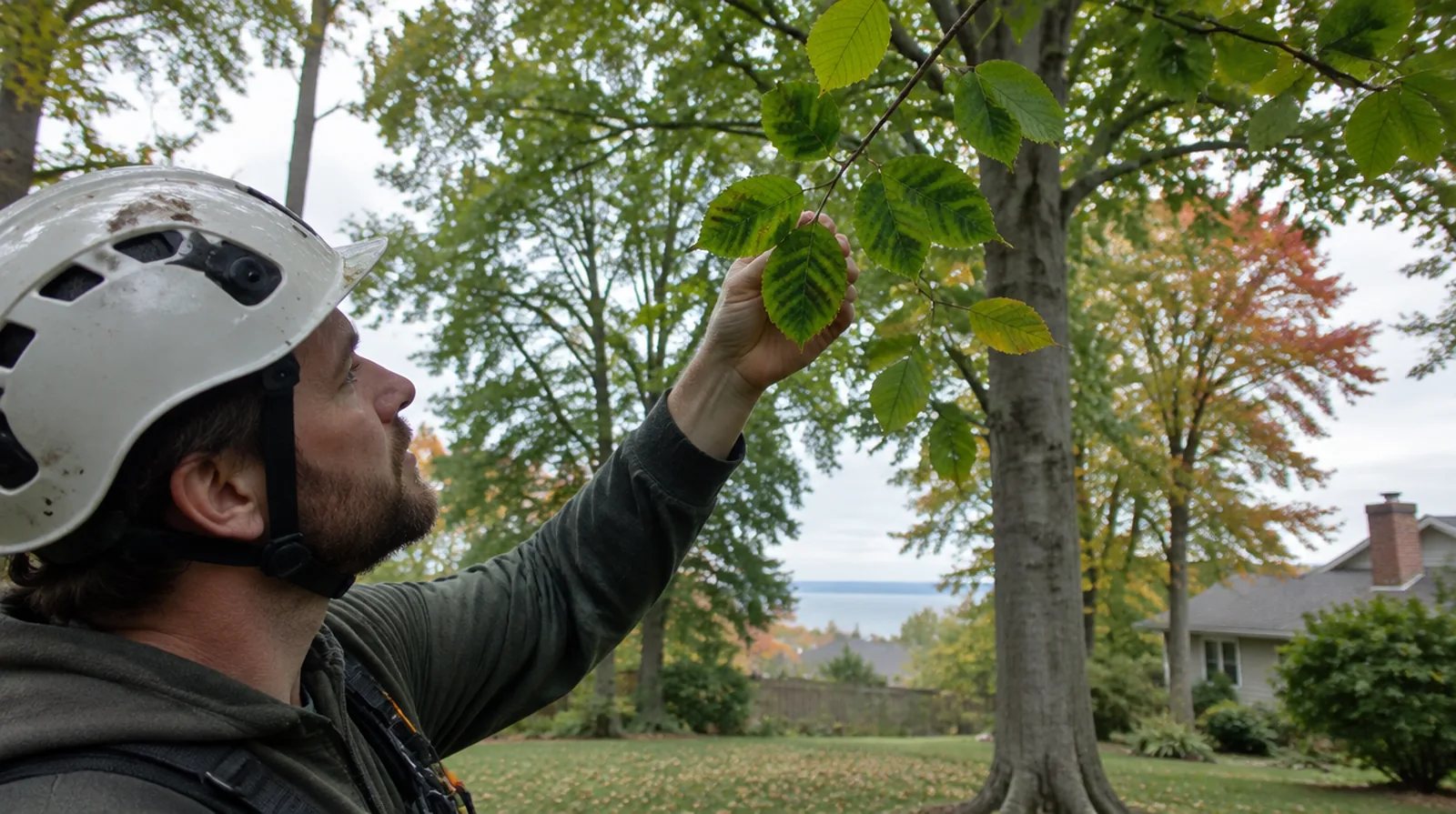
We walk the property with you and look at each tree you are worried about from the roots up. That means checking the root flare for girdling roots, fungus or soil heaving, the trunk for cracks, cavities and loose bark, and the crown for dead wood, thin foliage and weak forks. We note what the tree is near, such as the house, the driveway, a fence line or the neighbor's garage, because a defect over open lawn and the same defect over a bedroom are very different problems.
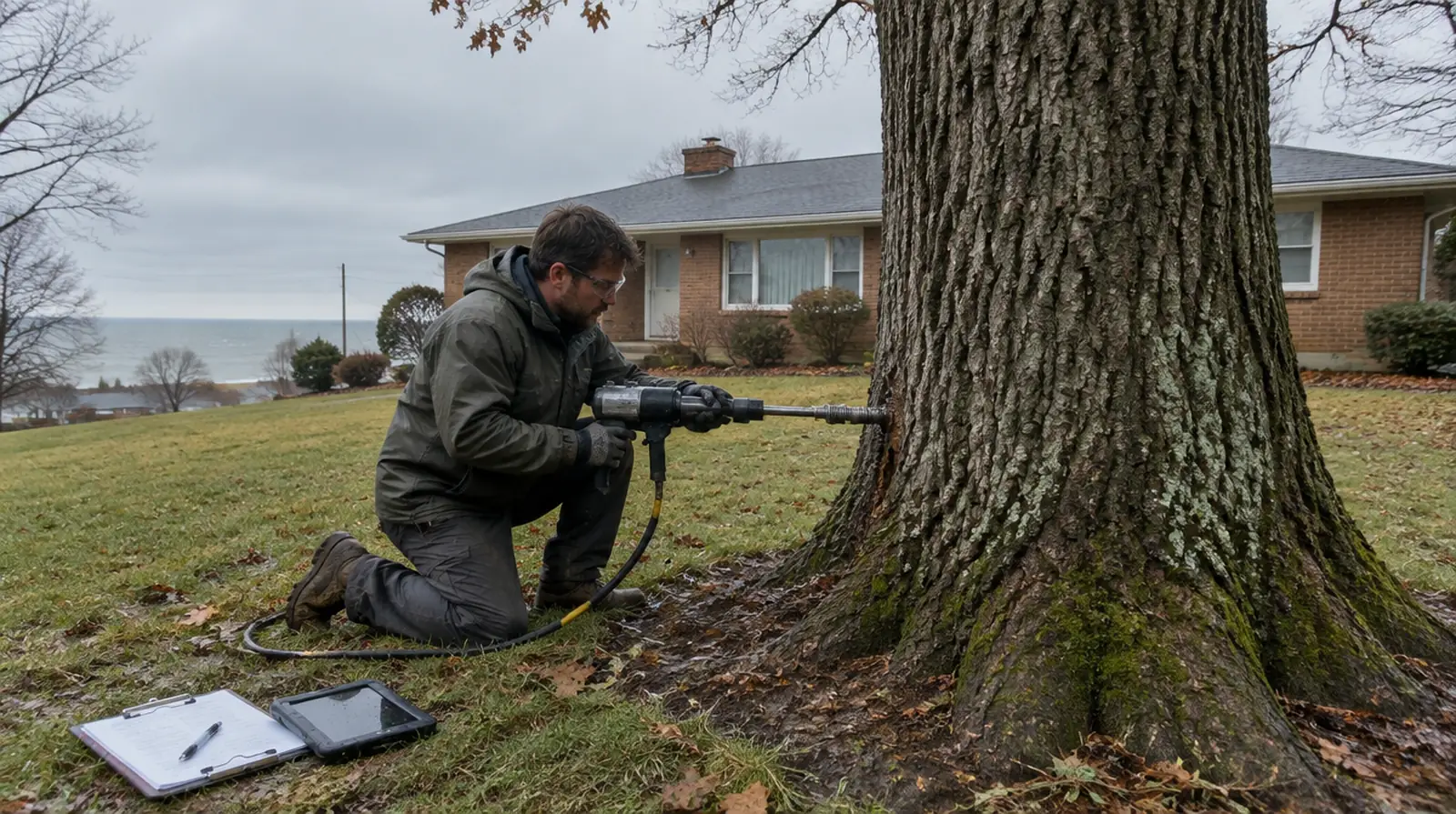
When something looks suspicious inside the trunk, we can go further. Sounding with a mallet finds hollow spots. A resistance drill sends a thin needle through the wood and graphs how solid it is, showing how much sound wood is left around decay. That tells you whether a big old oak is still strong or is a shell.
What do we see most around Millcreek?
Beech leaf disease
Beech leaf disease was first found in North America along Lake Erie in Ohio in 2012 and has spread east along the lakeshore. It is caused by a tiny nematode that lives in the leaves. Look for dark stripes between the leaf veins, leaves that turn leathery or cupped, and a canopy that gets thinner each year. There is no cure yet. Some treatments applied by certified applicators may slow it, and good mulching and watering help a stressed tree. We can tell you if your beech has it and what your options are.
Spotted lanternfly
Erie County has been an area of close watch for spotted lanternfly. An egg mass was found in Millcreek in 2025, and the grape region along the lake is a major part of the state's wine and grape industry. Lanternflies favor tree-of-heaven, but they also feed on maples, black walnut and other trees. If you spot the gray, speckled egg masses or the red-winged adults, report them to the Pennsylvania Department of Agriculture. We can help remove tree-of-heaven, which is often the first step.
Old storm damage and decay
Wind off the lake and heavy wet snow break limbs every year. A tear left by a broken branch can let decay into the trunk, which may not show for years. Many of the large silver maples, oaks and ash trees in neighborhoods off Peach Street and West 38th were planted decades ago, and age alone brings more of these hidden problems.
What do you get afterward?
You get a clear answer for each tree: keep it as is, care for it, watch it, or remove it, with the reason. Care might be pruning out deadwood, reducing a heavy limb, adding a cable to a weak fork, fixing mulch piled against the trunk or watering during a drought. If removal makes sense, we say so plainly. If it does not, we will not push it. For property sales, insurance questions or a dispute with a neighbor over a tree, we can put our findings in writing with photos.
When should you call?
- Mushrooms or conks growing at the base or on the trunk
- A crack, cavity or seam that seems to be growing
- Leaves coming in small, pale, striped or sparse
- The tree suddenly leaning, or soil lifting on one side
- Construction planned near a tree you want to save
- Before buying a house with big trees on the lot
What does a consultation cost?
A basic walk-through is quick and is often part of a free estimate when work is likely. Detailed decay testing, multiple trees and written reports take more time and are priced up front. You will know the cost before we start.
Questions about arborist visits
Can a sick tree be saved?
Sometimes. Trees with early, limited problems often recover with the right care. Trees with widespread decay or advanced disease usually do not, and it is better to plan removal than wait for a storm to decide.
Is a consult worth it for one tree?
For a large tree near the house, yes. The cost is small compared with an unneeded removal or a failure onto the roof.
What comes next if work is needed?
We can handle it, from careful pruning to support cabling, or removal when there is no better choice.
Not sure what your tree needs?
Call (814) 622-4677 and set up a walk-through. We will look at the trees with you and explain what we find.